Insights
AI in Disputes: Practical Risks Before Mediation or Court
June 2026
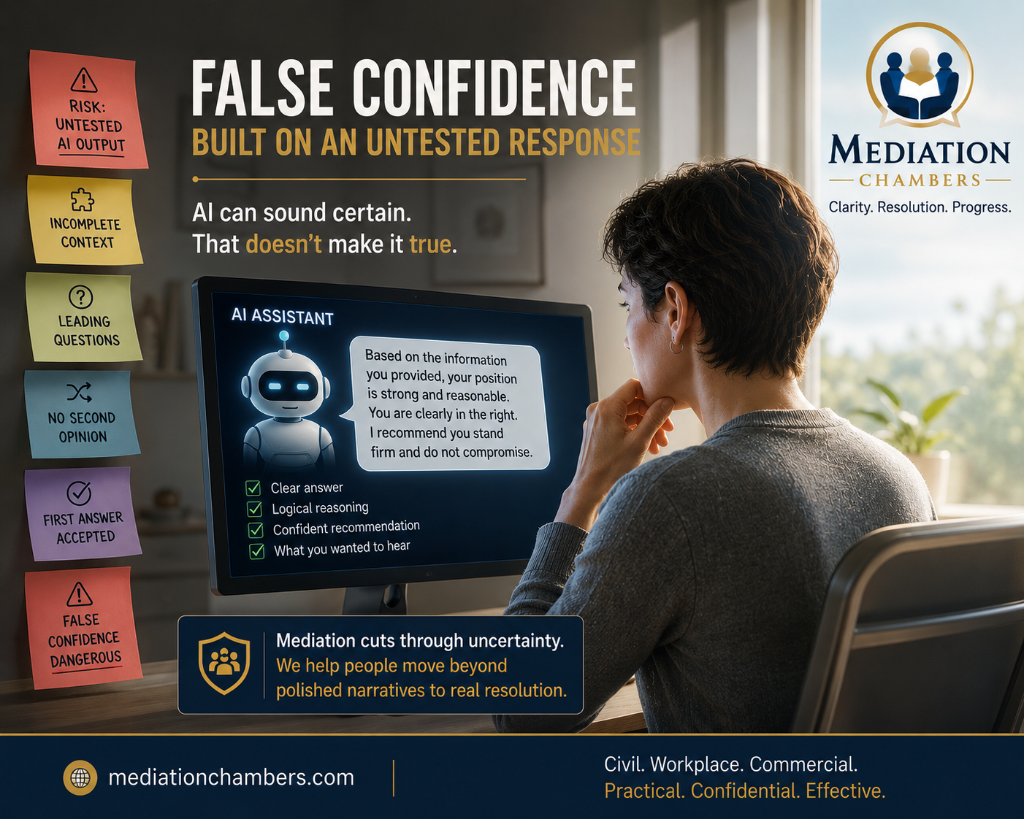
A growing number of disputes now arrive with AI already somewhere in the background.
A client has used ChatGPT to summarise events. A party has drafted a position note with an AI tool. A representative has used AI for research, chronology work, or first-draft wording. Sometimes that use is sensible and limited. Sometimes it creates a new problem inside the original dispute.
That matters because AI does not only raise technical questions. It raises questions about accuracy, confidentiality, privilege, fairness, and responsibility. The Bar Standards Board's current guidance puts those points at the centre of competent legal practice: technology can be useful, but only where it is used with enough understanding, control, and judgment to avoid harming the client or misleading the court.
For civil, workplace, and commercial mediation, the point is practical. If the documents, summaries, evidence, or settlement positions going into the process have been shaped by AI, that can affect the reliability of the information, the confidentiality of the material, and the quality of the discussion that follows.
Why AI is now part of dispute resolution, even when no one planned it
One of the clearest points in the guidance is that professionals need a basic level of AI competence even if they do not actively adopt AI themselves. That is because clients, solicitors, courts, and opposing parties may already be using it, and because AI-generated materials, prompt histories, and AI-assisted submissions may affect the way a dispute develops.
That is easy to see in practice. A party may come to mediation relying on an AI-generated summary of the facts. An opponent may produce a position statement that looks polished but contains errors in emphasis or analysis. A litigant in person may arrive with arguments generated by a public AI tool without fully understanding their weaknesses. None of that means the material should be ignored. It does mean it should not be treated as reliable simply because it is coherent or confidently expressed.
Accuracy is the first practical risk
The guidance is direct on this point. AI systems can generate false citations, and that problem is only one example of a broader accuracy risk. More generally, AI-generated text may look persuasive without having followed the legal reasoning process a trained professional would use. The guidance also says users should not copy AI output directly into work product without reviewing, verifying, and adapting it.
In mediation, that matters because much of the process depends on a reasonably accurate shared understanding of the dispute. If one side enters the room with an AI-generated chronology, summary, or settlement analysis that is flawed, the mediation can lose time dealing with avoidable confusion. In some cases, the problem is not outright fabrication. It is overstatement, omission, or a false sense of certainty.
That is one reason AI can make a dispute look clearer than it really is. It can compress complexity into something that feels decisive, even where the underlying position is more qualified than the summary suggests.
Confidentiality and privilege can be put at risk very quickly
The second practical issue is confidentiality.
The guidance says that anyone using AI for client work must protect client confidentiality, consider data protection obligations, and think carefully about how the tool stores, processes, or learns from input data and prompts. It is especially cautious about general-purpose or free generative AI tools, noting that their terms may allow storage, reuse, or model training on user inputs, and that such tools are usually too high risk for legal work or client-specific tasks.
That is highly relevant to mediation. Parties sometimes assume they can safely paste a bundle, witness account, grievance file, contract history, or settlement note into a public AI system in order to "get organised" before negotiations. That may be one of the quickest ways to create a second problem. Once confidential material is handled carelessly, the issue is no longer just the original dispute. It becomes a dispute about how sensitive information has been used, exposed, or compromised.
Where mediation is valued for privacy and candour, that risk is especially serious.
AI can affect fairness as well as accuracy
The guidance also warns that AI systems tend to reflect bias in the data on which they are trained, and that this can affect the reliability of outputs and, in some circumstances, lead to unlawful discrimination if not recognised and mitigated. It urges extra caution in matters linked to vulnerability or protected characteristics, and recommends a risk-based approach which looks at the intended use, the specific tool, and the context in which it is being applied.
That matters in mediation because dispute resolution depends heavily on judgment. If AI-generated material frames one side as less credible, less reasonable, or less deserving because of bias embedded in the tool or the prompt, that can distort how the dispute is understood. The risk is not limited to court submissions. It can affect internal assessments, negotiation strategy, client advice, and the way a party describes the dispute before the mediation has even begun.
Responsibility does not move to the software
One of the strongest themes in the guidance is personal responsibility. If AI is used, the user remains responsible for the work, the decision-making, and the accuracy of what is ultimately relied on. The guidance also treats the use of AI tools as a form of outsourcing, while making clear that responsibility for the quality of the work does not pass to the software provider.
That is important in mediation because parties sometimes assume AI is only a drafting aid. In practice, once an AI-generated summary, offer, argument, or evaluation influences the case, it is part of the dispute process. If it is wrong, careless, or misleading, the responsibility still rests with the person who chose to use it.
For dispute participants, that means AI should be treated as a tool that may assist with low-risk tasks, not as something that replaces judgment.
Transparency may matter, but context still matters too
The guidance takes a measured approach to disclosure. It says that clients should be told about AI use where it materially affects the nature or scope of the service, particularly where sensitive data is being processed by another party or where the use of AI changes what the client is receiving in a meaningful way. At the same time, it recognises that low-risk or de minimis use, such as minor editing of non-sensitive material, may not always require separate explanation.
For mediation, the practical question is not whether every spelling or formatting assist needs to be declared. It is whether the use of AI has materially shaped the substance of the case, the handling of confidential information, or the advice being given. If it has, transparency may become part of acting properly and maintaining trust in the process.
What this means before mediation
The most useful lesson from the guidance is not "do not use AI". It is "use it only where the task, the tool, and the safeguards make sense together".
Before mediation, that usually means asking practical questions:
- What exactly is the tool being used for?
- Is the task low risk or high risk?
- Has any client-specific or confidential material been entered?
- Has the output been checked independently?
- Is the material being relied on for substance, or only for admin support?
- Would the client understand and accept how the tool has been used?
That kind of disciplined approach is closer to the guidance's risk-based model than a blanket assumption that AI is either safe or unsafe in all settings.
A sensible place for AI in mediation preparation
In practical terms, AI may have a place in lower-risk administrative or organisational tasks. The guidance itself recognises that lower-risk uses may include general administrative work, minor edits, reminders, or other uses that do not involve sensitive client details or direct legal reasoning. It treats higher-risk uses very differently, especially text generation, drafting, court submissions, automated features, and general-purpose tools without adequate data protections.
That distinction is useful for mediation work. A cautious administrative use is not the same as uploading confidential case documents into a public model and asking it to produce a liability summary or settlement strategy. Those are not the same risk, and they should not be treated as though they are.
Mediation Chambers and AI-related dispute issues
Mediation Chambers is a mediation practice working with independent mediators. As AI becomes more common in workplace, civil, and commercial disputes, mediation is often a useful space to address not only the original disagreement, but also the secondary issues created by how information has been handled, summarised, shared, or relied on.
Where AI use has affected trust, confidentiality, accuracy, or the way a dispute has been framed, mediation can help the participants identify what has actually happened, narrow what remains in issue, and explore a practical way forward.
Frequently Asked Questions
Can AI be used to prepare for mediation?
Yes, but with caution. Lower-risk administrative uses may be easier to justify than using AI to draft substantive arguments, analyse confidential evidence, or produce unverified legal conclusions. The more sensitive the task, the stronger the need for verification, judgment, and data protection.
Can I upload dispute documents into a free public AI tool?
That is usually a bad idea. Free or general-purpose generative AI tools may permit storage, reuse, or training on user inputs and are generally too high risk for legal work or client-specific tasks.
Are AI-generated summaries reliable enough to use in a dispute?
Not without careful checking. AI can generate false citations and more general inaccuracies, so outputs should be independently verified rather than copied straight into work product.
Does using AI remove personal responsibility for the work?
No. The person using the tool remains responsible for the work, the decisions taken, and the accuracy of what is relied on.
Do clients need to be told if AI has been used?
Sometimes. Transparency matters where AI materially affects the nature or scope of the service, especially where sensitive data is processed by another party or the use of AI materially changes what the client is receiving. Lower-risk, minor use may not always require separate explanation.
What if the other side is using AI badly?
That is now a practical possibility in many disputes. Parties and representatives should be alert to the risks AI use creates for accuracy, privilege, and client understanding.
Further reading: What Happens in Mediation, Mediation FAQs, Mediation vs Litigation, and Can Courts Order Mediation?
Discuss Your Dispute
A brief, confidential initial conversation to understand whether mediation may assist.
Get in TouchMore Insights
- AI May Spare Junior Jobs. It Could Still Break the Leadership Pipeline.
- Mediation vs Litigation: Why Being Sure You Will Win Is Not Enough
- The Value of Mediation in Complex Insurance Claims
- What Happens If the Other Party Refuses to Mediate?
- The Role of Lawyers in Mediation
- Why Many Civil Disputes Settle Before Trial
- All Articles →