Insights
Mediation vs Litigation: Why Being Sure You Will Win Is Not Enough
April 2026
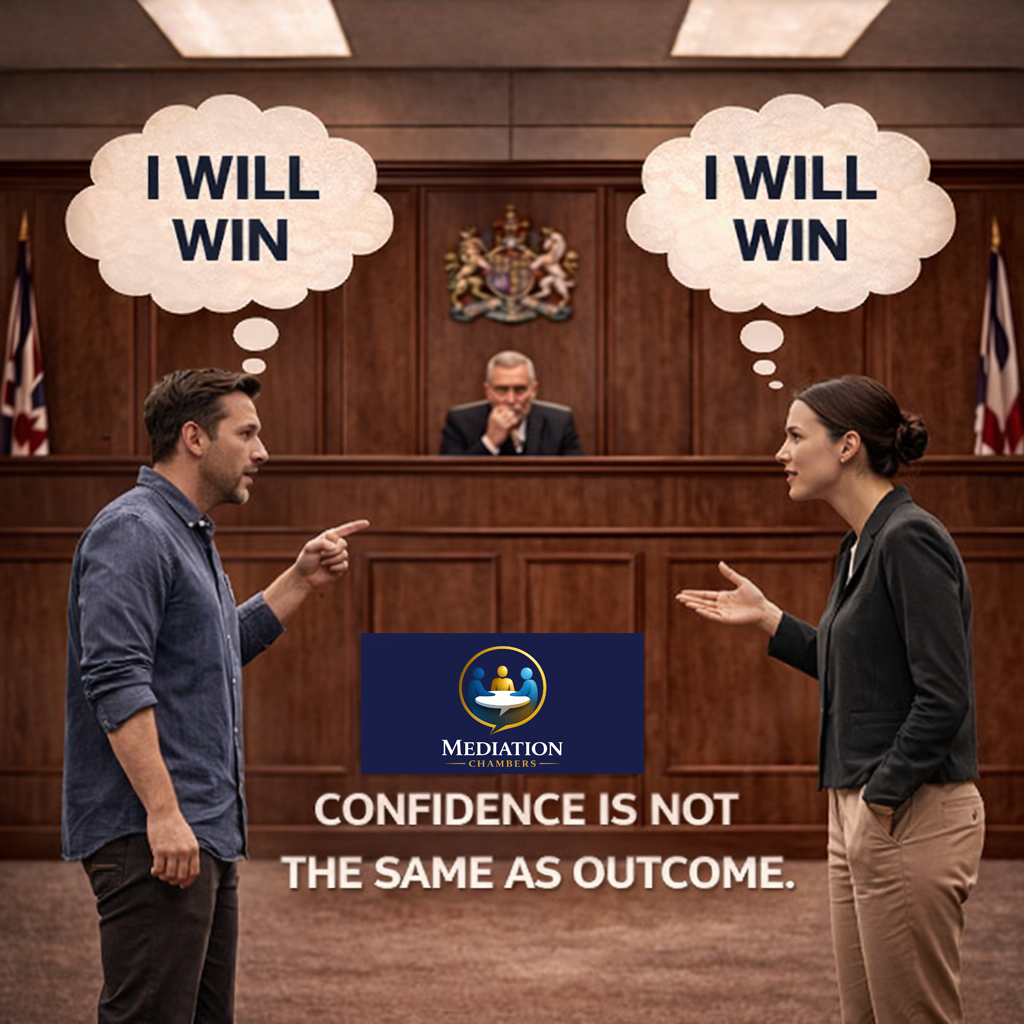
Why Being Sure You Will Win Does Not Resolve a Dispute
At the start of many disputes, both sides often say some version of the same thing: once a judge, tribunal, or other decision-maker sees the facts properly, the answer will be obvious.
That confidence is understandable. Each participant knows the strongest parts of their own case best. Each tends to assume the documents, messages, chronology, or witnesses point in one direction. From inside the dispute, the outcome can feel much clearer than it really is.
The difficulty is that once a matter enters a formal legal process, the outcome stops belonging to the participants. The dispute is then filtered through legal tests, procedural rules, evidential questions, and the interpretation of a judge or tribunal. That structure is necessary, but it also means the case is decided through a legal framework rather than through either side's personal sense of what is fair or obvious. This applies across commercial, civil, and workplace disputes alike.
Why Certainty Often Looks Stronger From Inside the Dispute
A dispute usually develops long before anyone sees a courtroom or tribunal room. By then, each side has had weeks or months to build its own explanation of events. People do not just form a view of what happened. They form a view of what the other side was trying to do, what the documents mean, and what any reasonable outsider would conclude.
That is one reason formal proceedings can surprise people. The process does not ask whether the outcome feels obvious from inside the dispute. It asks whether the available evidence, legal tests, and procedural rules support the case in the way the court or tribunal sees it.
This is not a flaw in the system. It is the function of adjudication. But it does mean that confidence is not the same thing as control. Courts now also have express power to order parties to engage in dispute resolution — see Can Courts Order Mediation?
What a Formal Judgment Is Designed to Do
A formal judgment is there to decide legal issues. That can be essential where rights need to be determined, liability has to be established, or a binding ruling is needed.
What it does not always do is solve the whole practical problem. A court or tribunal may decide who succeeds on the issues before it, but that still may not answer the questions that matter most to the people involved: how they will work together next, how a commercial relationship will be unwound, what happens to communication going forward, or whether there is a more proportionate outcome than a straight win-lose result.
That gap is often where disputes become more costly than expected. The legal question gets answered, but the practical problem remains. Understanding how the mediation process works highlights that contrast clearly.
Why Mediation Changes the Shape of the Conversation
Mediation is built around a different idea. Rather than handing the outcome to a third party, the participants retain control over whether a resolution is reached and what that resolution looks like.
That matters because mediation allows the parties to assess risk, test positions, and negotiate seriously without losing control of the decision itself.
In many disputes, that is the practical advantage. The question stops being, "Who will a judge prefer?" and becomes, "Is there an outcome both sides can live with that is better than the risk, cost, delay, and rigidity of formal determination?" For more on what happens when one side declines to engage, see What Happens If the Other Party Refuses to Mediate.
The Value of Flexibility in Workplace Disputes
A grievance outcome or tribunal judgment may answer an important legal or procedural question, but it will not usually build a workable framework for meetings, communication, boundaries, escalation routes, or review points. Mediation can.
It can allow participants to agree practical arrangements about how they will work together, how concerns will be raised, what conduct is expected, and how problems will be handled if they arise again. In many workplace disputes, that is the part of the resolution that matters most in practice.
The Value of Flexibility in Civil and Commercial Disputes
The same point applies in civil and commercial matters. A claim may be framed around breach, payment, delay, or liability, but the practical resolution may involve staged payments, revised performance obligations, a managed exit, a confidentiality term, a handover process, or a commercial adjustment that no court would usually design for the parties.
That does not mean mediation is soft or vague. It means it allows a wider range of practical outcomes than a formal decision usually can. In many business disputes, that flexibility is what makes settlement commercially sensible rather than merely legally possible.
Mediation Can Narrow the Dispute, Not Only Settle It
Mediation does not have to produce an all-or-nothing result to be useful.
In some cases, the participants reach agreement on part of the dispute but not all of it. That can still be a strong outcome. If some issues are resolved, only the remaining points need to be left to adjudication. This can reduce the size of the dispute, the cost of taking it forward, and the number of variables left in play.
In some matters, the substantive case is resolved and only costs remain to be decided. Even where mediation does not end proceedings entirely, it can narrow what the court or tribunal is actually being asked to determine. That often makes the remaining process more proportionate and less risky than leaving every issue to be fought out at a final hearing. See also Why Many Civil Disputes Settle Before Trial.
Why Considering Mediation Is Not a Weak Move
Choosing mediation is not an admission that a case lacks merit. In many disputes, it reflects the opposite. It shows a clear understanding that even a strong case carries risk once the outcome is handed to a third party.
The practical question is not always whether one side believes it should win. It is whether the outcome genuinely needed can be reached more effectively through structured negotiation than through a binary imposed decision after months of cost and uncertainty. See Mediation Fees for more on cost comparisons.
When a Formal Decision May Still Be Necessary
None of this means mediation replaces litigation or tribunal proceedings in every case.
Some disputes need urgent court orders. Some need formal findings. Some involve issues that cannot realistically be resolved through negotiated compromise. Mediation is not a substitute for adjudication where adjudication is what the case genuinely requires.
But many disputes do not start there. They start with two people or organisations who are each convinced they will win, when the more useful question is whether there is a better route to resolution before the outcome is reduced to a binary decision.
Mediation Chambers and Practical Dispute Resolution
Mediation Chambers is a mediation practice working with independent mediators. Across civil, workplace, and commercial disputes, mediation through Mediation Chambers offers a structured and confidential process for exploring settlement before the available outcomes narrow to a formal imposed decision.
Where the real issue is control, practicality, confidentiality, or the need for a workable way forward, mediation may provide more room for resolution than litigation alone.
Frequently Asked Questions
Can mediation happen after court or tribunal proceedings have started?
Yes. Mediation can take place before proceedings are started or while they are ongoing. In some cases, proceedings are paused to allow mediation to take place.
Is offering mediation a sign that your case is weak?
No. Offering mediation is not a sign of weakness. It is often a sign that a participant understands the cost, uncertainty, and limits of formal adjudication and wants to explore whether there is a better route to resolution.
Can mediation include outcomes a court or tribunal would not usually impose?
Often, yes. Mediation can include practical agreed steps such as future working arrangements, communication expectations, behaviour commitments, review points, confidentiality terms, commercial adjustments, or staged arrangements for ending or reshaping a relationship.
Does the mediator decide who is right?
No. The mediator does not impose the outcome. The participants remain in control of whether they settle and on what terms.
Discuss Your Dispute
A brief, confidential initial conversation to understand whether mediation may assist.
Get in TouchMore Insights
- The Value of Mediation in Complex Insurance Claims
- What Happens If the Other Party Refuses to Mediate?
- The Role of Lawyers in Mediation
- Can Courts Order Mediation? What Happens If You Refuse?
- Why Courts and Government Are Increasingly Promoting Mediation
- Mediation in 2026: Why It Is Harder to Ignore Before Going to Court
- All Articles →