Insights · May 2026
Mediation in 2026: Why It Is Harder to Ignore Before Going to Court
A practical guide to why mediation is harder to ignore in 2026, including Churchill, CPR changes, costs risk, and what this means before court proceedings.
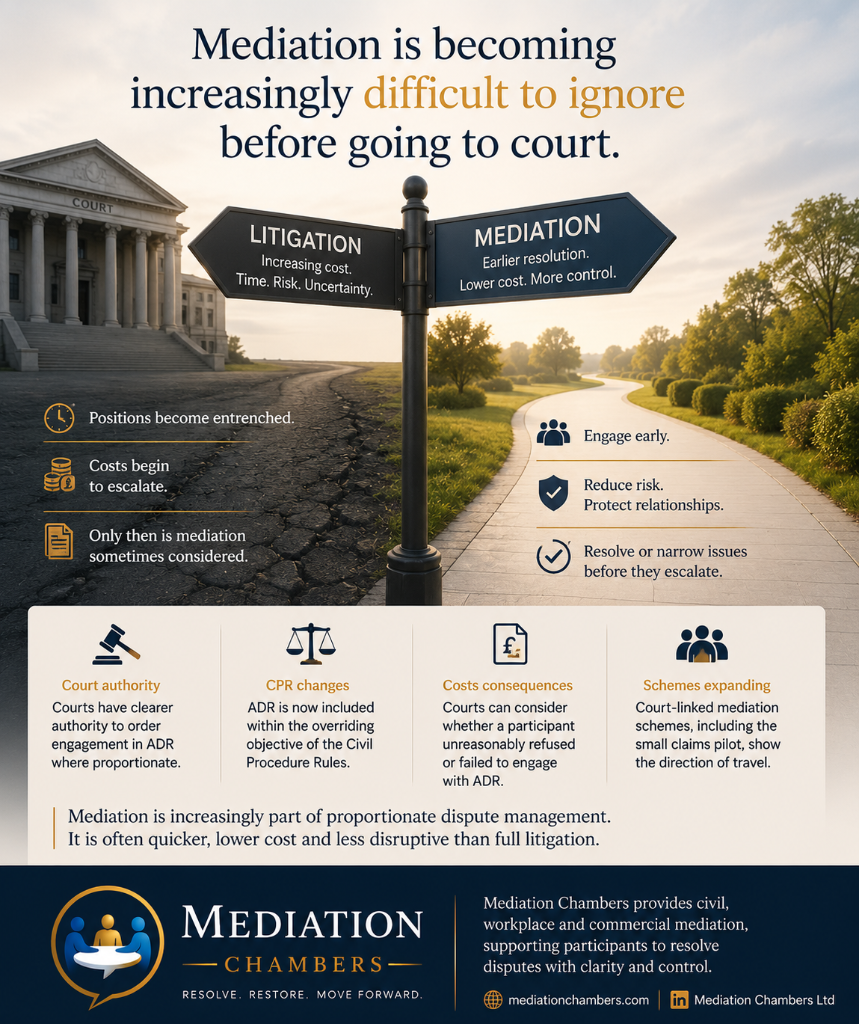
For a long time, many parties treated mediation as something to discuss later. The claim would be issued first. Positions would be set out. The legal process would begin. Mediation, if it happened at all, was often seen as a side issue rather than part of the real dispute strategy.
In 2026, that is harder to justify. The legal position in England and Wales has moved on. Courts now have clearer authority to order parties to engage in non-court dispute resolution, the Civil Procedure Rules now place alternative dispute resolution within the overriding objective itself, and the costs rules expressly allow the court to take into account a failure to comply with an ADR order or an unreasonable failure to engage in ADR.
That does not mean mediation is mandatory by statute across every civil and commercial dispute. But it does mean that treating mediation as optional in any practical sense is becoming much harder. In many cases, the real question is no longer whether mediation can simply be declined, but whether a refusal can be justified if the court later looks at the parties' conduct.
Why 2026 feels different
The most important shift came with Churchill v Merthyr Tydfil County Borough Council. In that case, the Court of Appeal made clear that the court can lawfully stay proceedings for, or order parties to engage in, a non-court dispute resolution process, provided the order does not impair the right to a judicial hearing and is proportionate to the legitimate aim being pursued. The judgment also made the practical point that mediation and other non-court processes are, in general terms, quicker and cheaper than court-based solutions.
That matters because it changed the argument. The old assumption that compulsory mediation was not really available is no longer a safe working assumption. The court's power is clearer, and the discussion has moved from whether ADR can be required at all to when it is proportionate to require it.
Mediation is now built into the procedure, not left outside it
The CPR now reflect that shift more directly. Part 1 states that dealing with cases justly and at proportionate cost includes "promoting or using alternative dispute resolution", and the parties are required to help the court further that overriding objective. The court must actively manage cases, and the modern rules treat ADR as part of that case management landscape rather than as a separate goodwill exercise.
The pre-action rules point in the same direction. Before proceedings are started, parties are expected to exchange enough information to understand each other's position, decide how to proceed, try to settle the issues without proceedings, consider ADR, and reduce the costs of resolving the dispute. The practice direction also says litigation should be a last resort, that parties should continue to consider settlement even after proceedings have started, and that if proceedings are issued the court may require evidence that ADR has been considered. Silence or refusal can be treated as unreasonable and can lead to costs consequences.
That is why mediation now sits much earlier in the life of a dispute. It is no longer just something to discuss on the eve of trial. In many cases, it is something the court expects the parties to have addressed properly before the claim is even far advanced.
What refusal now risks
The practical risk is not limited to judicial criticism. CPR 44.2 says the court will have regard to all the circumstances when making costs orders, including the conduct of the parties, and it now expressly includes whether a party failed to comply with an order for ADR or unreasonably failed to engage in ADR. CPR 44.4 also directs the court, when deciding the amount of costs, to look at the parties' conduct before and during proceedings and the efforts made to try to resolve the dispute.
That does not mean every refusal will be punished. There may still be cases where mediation is not proportionate, where urgent relief is needed, or where the timing makes no practical sense. But the burden is now heavier on the party resisting mediation. A bare statement that the case is strong, or that mediation will not work, is much less likely to be enough on its own.
Small claims show the direction of travel
The direction of travel is clearest in the County Court small claims system. Practice Direction 51ZE provides for an automatic referral to mediation pilot for specified money claims in the small claims track. The pilot runs from 22 May 2024 to 6 April 2027. Where it applies, claims are referred to the HMCTS Small Claims Mediation Service, and if a matter still goes to a final hearing the court must consider whether any sanction is appropriate in light of whether the parties attended mediation. The rules also allow the court to take failure to attend into account when exercising its discretion on costs.
HMCTS guidance reflects the same practical approach. It tells parties that if they have been told they must attend mediation, they will be given an appointment, and the government's consultation response says mediation is being integrated into the process for relevant Part 7 small claims, with appointments continuing to be offered within 28 days after the Small Claims Mediation Service receives the case details.
This does not mean every civil dispute is now under a single mandatory mediation regime. It does mean the system is moving steadily towards earlier and more structured use of ADR, especially in lower-value claims and in cases where proportionate resolution matters.
Why this matters in practice
For businesses, employers, professionals, and individuals involved in civil or commercial disputes, the main point is practical rather than academic. Mediation is no longer something to treat as a soft option or a procedural extra. It has become part of the risk analysis of litigation itself.
A party thinking about proceedings now needs to consider not only the merits of the claim, but also how its conduct will look if the court later asks what was done to resolve the dispute earlier. Was mediation proposed? Was it properly considered? If it was refused, was there a clear reason? Was the refusal recorded at the time? Those questions are no longer peripheral. They go to costs, case management, and credibility.
Mediation is still about resolution, not box-ticking
None of this means mediation should be approached as a procedural hurdle only. That is often a mistake in itself.
The more useful view is that mediation remains a practical opportunity to resolve part or all of a dispute before the available outcomes become narrower, more expensive, and more dependent on a judge's decision. It can also narrow the live issues even if it does not produce a complete settlement. If some points are resolved, only the balance needs to be left for adjudication. In many disputes, that is a materially better position than leaving every issue to be decided at trial.
That is one reason the courts' increasing emphasis on mediation matters. It is not only about pressure. It is also about proportion. Many disputes do not need every issue to be fought through to a final hearing in order to reach a workable outcome.
Mediation Chambers and practical dispute resolution
Mediation Chambers is a mediation practice working with independent mediators. Across civil, workplace, and commercial disputes, mediation through Mediation Chambers offers a structured and confidential process for exploring resolution before the constraints of formal proceedings become harder to reverse.
Where the real issue is cost, delay, uncertainty, confidentiality, or the need to preserve commercial or working relationships, mediation may provide a more proportionate route than allowing the dispute to move deeper into formal litigation.
Discuss Your Dispute
Mediation Chambers can help parties explore resolution privately and practically, before the constraints of formal proceedings become harder to reverse.
Arrange an Initial ConsultationFrequently Asked Questions
Is mediation mandatory in every civil case in 2026?
No. There is no single statute making mediation mandatory across all civil claims in England and Wales. But the court can order parties to engage in non-court dispute resolution where that is proportionate, the CPR now place ADR within the overriding objective, and the costs rules allow the court to take ADR failures into account. In practice, that makes mediation much harder to ignore.
Can the court order mediation in a commercial dispute?
Yes. After Churchill, the court can lawfully stay proceedings for, or order parties to engage in, a non-court dispute resolution process, provided that does not impair the right to a judicial hearing and is proportionate to the legitimate aim being pursued.
What happens if a party refuses mediation?
That depends on the circumstances, but the refusal is no longer risk-free. The pre-action practice direction says a refusal or silence in response to an ADR invitation may be treated as unreasonable, and CPR 44.2 allows the court to take into account a failure to comply with an ADR order or an unreasonable failure to engage in ADR when deciding costs.
What Happens If the Other Party Refuses to Mediate →Do parties have to think about mediation before issuing proceedings?
Generally, yes. The pre-action rules say parties should exchange enough information to understand each other's position, try to settle without proceedings, consider ADR, and reduce costs before issuing a claim. They should also continue to consider settlement after proceedings have started.
Is mediation now built into the small claims process?
For specified money claims within the current pilot, yes. Practice Direction 51ZE provides for automatic referral to the HMCTS Small Claims Mediation Service for claims within scope, and if the matter reaches a final hearing the court must consider whether sanctions are appropriate in light of attendance at mediation.
Does mediation have to settle the whole case to be useful?
No. Mediation can still be worthwhile if it narrows the dispute, resolves part of the claim, or reduces the number of issues that need to be left to the court. That can improve proportionality, reduce cost, and lower the uncertainty of the remaining proceedings.
Discuss Your Dispute
A brief, confidential initial conversation to understand whether mediation may assist.
Get in TouchMore Insights
- Mediation vs Litigation: Why Being Sure You Will Win Is Not Enough
- The Value of Mediation in Complex Insurance Claims
- What Happens If the Other Party Refuses to Mediate?
- The Role of Lawyers in Mediation
- Can Courts Order Mediation? What Happens If You Refuse?
- Why Courts and Government Are Increasingly Promoting Mediation
- All Articles →
Arrange an Initial Consultation
This is typically a brief conversation to explain the mediation process and understand whether Mediation Chambers may be appropriate for your situation.
Arrange an Initial Consultation