Insights · June 2026
Why Governments and Businesses Should Invest More in Mediation
A practical guide to why mediation supports economic growth, business continuity, and court efficiency, with evidence from the UK, Kenya, India, Singapore, Australia, and the World Bank.
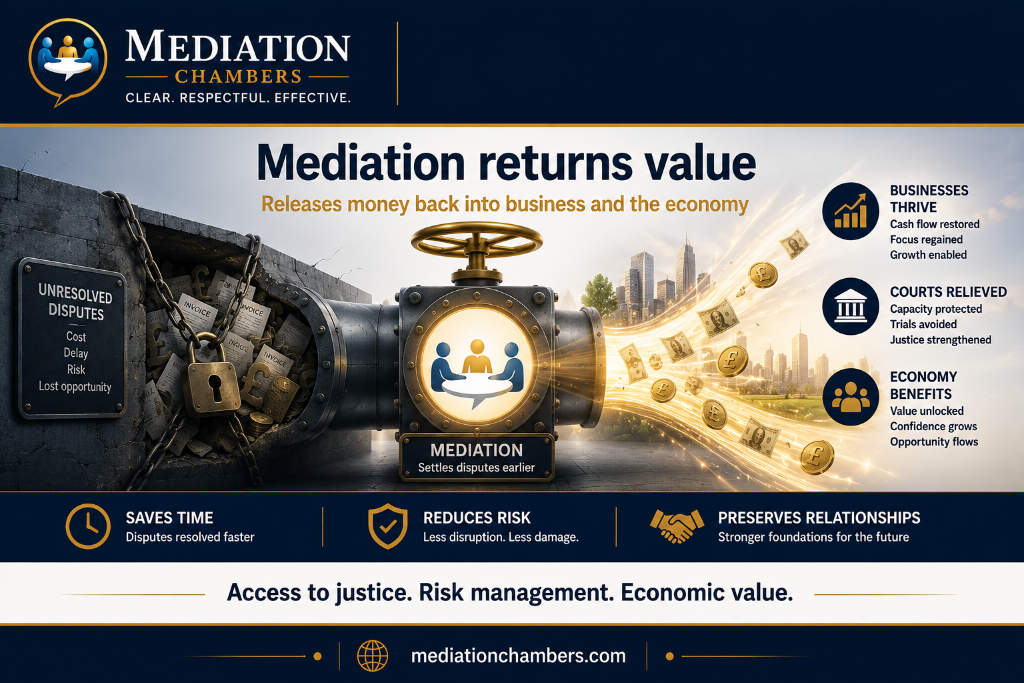
When disputes sit unresolved, the cost is not confined to legal fees. Cash is tied up. Management time is diverted. Projects slow down. Commercial relationships weaken. Court time is consumed by cases that may never have needed a full hearing in the first place.
That is why mediation matters beyond the legal sector. At scale, it is not only a method of resolving disputes. It is a way of releasing economic value that would otherwise remain trapped in conflict.
The evidence is now broad enough to make that point seriously. In the UK, CEDR's 2025 audit estimated annual savings to business of £5.9 billion and cumulative savings since 1990 of £50 billion, while also reporting around 21,000 civil and commercial mediations and an 87% aggregate settlement rate. In Kenya, the Judiciary says court-annexed mediation has generated about KES 52.2 billion in resolved case value and restored more than 8,100 family relationships. In India, the official report for the National Lok Adalat held on 14 March 2026 records total settlement value of roughly ₹237.8 billion in a single national sitting. Singapore Mediation Centre reports more than S$14 billion in matters mediated since 1997. The Supreme Court of Victoria says judicial mediation saved 1,484 trial days in 2024–25, with a further 381 hearing days saved in the Costs Court, while Victoria's small business commission reports that 33% of disputes were resolved before formal mediation and 69% of formal mediations resolved in 2024–25.
The consistent point is straightforward. Mediation does not only settle disputes. It helps release money, reduce court pressure, shorten disruption, and preserve economic activity that would otherwise be damaged by delay and escalation. That is why governments and businesses should be pushing further towards it.
Unresolved disputes are an economic drag
A dispute rarely affects only the people named in the case. In business, it can interrupt payments, delay delivery, freeze decisions, and absorb senior management attention. In public systems, it can consume court capacity and extend waiting times for everyone else.
CEDR's UK estimate is useful for that reason. Its savings figure is not limited to lawyers' bills. It includes wasted management time, damaged relationships, lost productivity, and legal fees. That is a more realistic picture of what commercial conflict costs in practice.
The World Bank now frames access to mediation in similar economic terms. Its B-READY 2025 work says businesses lack access to commercial mediation in 44% of the economies measured so far, and notes that having no practical access to mediation can negatively affect business operations, make firms more risk-averse, and in some cases push firms out of business after capital has been tied up in unresolved disputes.
That is why mediation is better understood as part of economic infrastructure, not merely as a legal service. Where it is available and used well, it supports the conditions in which businesses can keep operating, investing, and settling problems without disproportionate delay.
The international evidence is no longer marginal
What is striking is not one headline figure in one country. It is the pattern across very different systems.
In England and Wales, the civil and commercial mediation market is now large enough for CEDR to describe around 21,000 mediations in 2024, with an 87% settlement rate and billions saved to business annually. In Kenya, the Judiciary expressly links court-annexed mediation to improved commercial conditions, saying resolved matters have generated about KES 52.2 billion in value. In India, one National Lok Adalat sitting on 14 March 2026 recorded settlement value of about ₹237.8 billion. Singapore Mediation Centre reports over 6,300 matters mediated, around 67% settled, and more than 90% of settled matters concluded within one day. In Victoria, the Supreme Court reports court-time savings in the thousands of days, while the small business system reports that many disputes are resolved before formal mediation even begins.
Those systems differ in structure, scale, and legal culture. What they share is the same practical outcome: economic value is preserved when disputes are resolved earlier, faster, and with less procedural waste.
Why governments should treat mediation as economic infrastructure
For government, the case for mediation is wider than court backlog reduction.
A mediation system that works properly can help free court capacity for the cases that genuinely require adjudication. It can release money tied up in pending disputes. It can improve the commercial environment for domestic businesses. It can also reduce the social cost of conflict in areas such as family, small business, and community disputes.
Kenya's official court-annexed mediation figures make that point clearly. The Judiciary does not present mediation only as a justice-sector reform. It explicitly says the resolved case value has improved the commercial environment, while also restoring thousands of family relationships. That combination matters. A system that reduces both economic friction and relational damage is doing more than case disposal.
The World Bank's B-READY 2025 analysis points in the same direction. It measures mediation within the broader business environment and finds that access is highest in high-income economies and much lower in low-income ones, with less than 20% availability and practice in the low-income group covered so far. That is a strong sign that commercial mediation is increasingly being treated internationally as part of the architecture of economic access and business confidence.
For governments, the implication is practical. If mediation helps capital move, reduces delay, and improves the conditions in which businesses operate, then investing in it is not a soft justice reform. It is an economic policy decision.
Why businesses should use mediation earlier
Businesses also have a direct reason to move earlier towards mediation.
Many commercial disputes are not valuable because they are "won" after months of process. They are valuable because they are resolved before they become more expensive than the underlying problem. A payment dispute, shareholder disagreement, contract issue, or supply-chain conflict can easily consume management time out of all proportion to the claim itself.
That is one reason the UK numbers matter. A mature mediation market with high settlement rates and multi-billion-pound savings suggests not only that mediation works, but that earlier commercial resolution is often cheaper than letting disputes harden into full litigation.
The Victorian small business data points the same way. If a third of disputes can be resolved before formal mediation, and a large majority of formal mediations then resolve as well, businesses are being shown something important: not every dispute needs to become a legal campaign before it becomes tractable.
For business leaders, the question is often not whether a legal claim is available. It is whether allowing the dispute to deepen is commercially rational.
Mediation is not only about saving legal fees
One reason mediation is sometimes undervalued is that it is described too narrowly.
Its benefit is not just that it may cost less than court. Its benefit is that it can protect commercial continuity. It allows businesses to deal with payment terms, delivery arrangements, confidentiality, future trading, phased exits, or project completion in a way that a judgment may not. That flexibility can matter as much economically as the reduction in legal spend.
Singapore's data is useful here. The value of matters mediated through Singapore Mediation Centre exceeds S$14 billion, but its operational point is equally important: about 67% of cases settle, and more than 90% of settled matters do so within one day. That is not simply a legal win rate. It is a business-time point. Speed has economic value in itself.
Victoria's court figures make the same point from the public side. Saving 1,484 trial days in the Civil Division and a further 381 days in the Costs Court is not only about convenience. It represents released judicial capacity and avoided litigation expense.
Wider adoption still needs deliberate policy
None of this happens by accident. Mediation becomes economically meaningful only when there is enough institutional support behind it.
That usually means clear court encouragement, credible mediator supply, enforceable settlements, informed legal and business users, and systems that make mediation normal rather than exceptional. The World Bank's finding that 44% of measured economies still lack practical access to commercial mediation shows the gap is not conceptual. It is institutional.
So the policy issue is not whether mediation sounds attractive in principle. It is whether governments, courts, regulators, and businesses are prepared to build the conditions in which it can operate at useful scale.
Where litigation still matters
None of this means every dispute should be mediated or that adjudication has become secondary.
Some disputes need urgent orders. Some need precedent. Some need formal findings or public determination. Courts remain essential. But that is exactly why mediation matters economically. The more that suitable disputes are resolved earlier, the more public adjudication can be focused on the matters that genuinely require it.
That is a better use of both private and public resources.
Mediation Chambers and practical dispute resolution
Mediation Chambers is a mediation practice working with independent mediators. Across civil, workplace, and commercial disputes, mediation through Mediation Chambers offers a structured and confidential process for exploring resolution before delay, cost, and disruption grow unnecessarily.
Where the real issue is business continuity, commercial value, management time, or the need for a practical settlement rather than a prolonged contest, mediation may offer a more proportionate route than allowing conflict to deepen.
Discuss Your Dispute
Mediation Chambers can help parties explore resolution privately and practically, before the constraints of formal proceedings become harder to reverse.
Arrange an Initial ConsultationFrequently Asked Questions
Why should governments invest more in mediation?
Because mediation can do more than reduce court backlogs. International data shows it can release money back into the economy, save judicial time, improve commercial conditions, and support faster resolution of disputes that would otherwise continue to consume public and private resources.
Does mediation really have an economic impact?
Yes. The figures are substantial. CEDR's 2025 audit estimated annual savings to UK business of £5.9 billion, Kenya's Judiciary reports around KES 52.2 billion in resolved case value through court-annexed mediation, and India's official report for the National Lok Adalat held on 14 March 2026 records settlement value of about ₹237.8 billion.
Why should businesses use mediation earlier?
Because delay is expensive even before a case reaches trial. Earlier mediation can reduce management distraction, preserve cash flow, protect relationships, and avoid a dispute becoming more costly than the underlying problem. The UK and Victoria data both point strongly in that direction.
Is mediation only useful in large commercial disputes?
No. It is useful across a wide range of disputes. The Victorian small business data shows meaningful results in lower-value business disputes, while Singapore, Kenya, India, and the UK show that mediation also works at larger scale and across different types of system.
What does the World Bank's B-READY data suggest about mediation?
It suggests mediation is increasingly being treated as part of business access and dispute-resolution infrastructure. B-READY 2025 found that businesses lack access to commercial mediation in 44% of the economies measured so far, with access highest in high-income economies and much lower in low-income economies.
Does mediation replace court?
No. Some disputes still need adjudication. But mediation can reduce the number of matters that need full court determination and can narrow the issues even where it does not resolve everything. That is part of why it has economic value.
Further reading: Civil Mediation, Commercial Mediation, Workplace Mediation, Contract Disputes, and Mediation vs Litigation.
Discuss Your Dispute
A brief, confidential initial conversation to understand whether mediation may assist.
Get in TouchMore Insights
- Mediation vs Litigation: Why Being Sure You Will Win Is Not Enough
- The Value of Mediation in Complex Insurance Claims
- What Happens If the Other Party Refuses to Mediate?
- The Role of Lawyers in Mediation
- Can Courts Order Mediation? What Happens If You Refuse?
- Why Courts and Government Are Increasingly Promoting Mediation
- All Articles →
Arrange an Initial Consultation
This is typically a brief conversation to explain the mediation process and understand whether Mediation Chambers may be appropriate for your situation.
Arrange an Initial Consultation