Insights
The Grievance Is Closed. The Conflict Continues.
November 2026
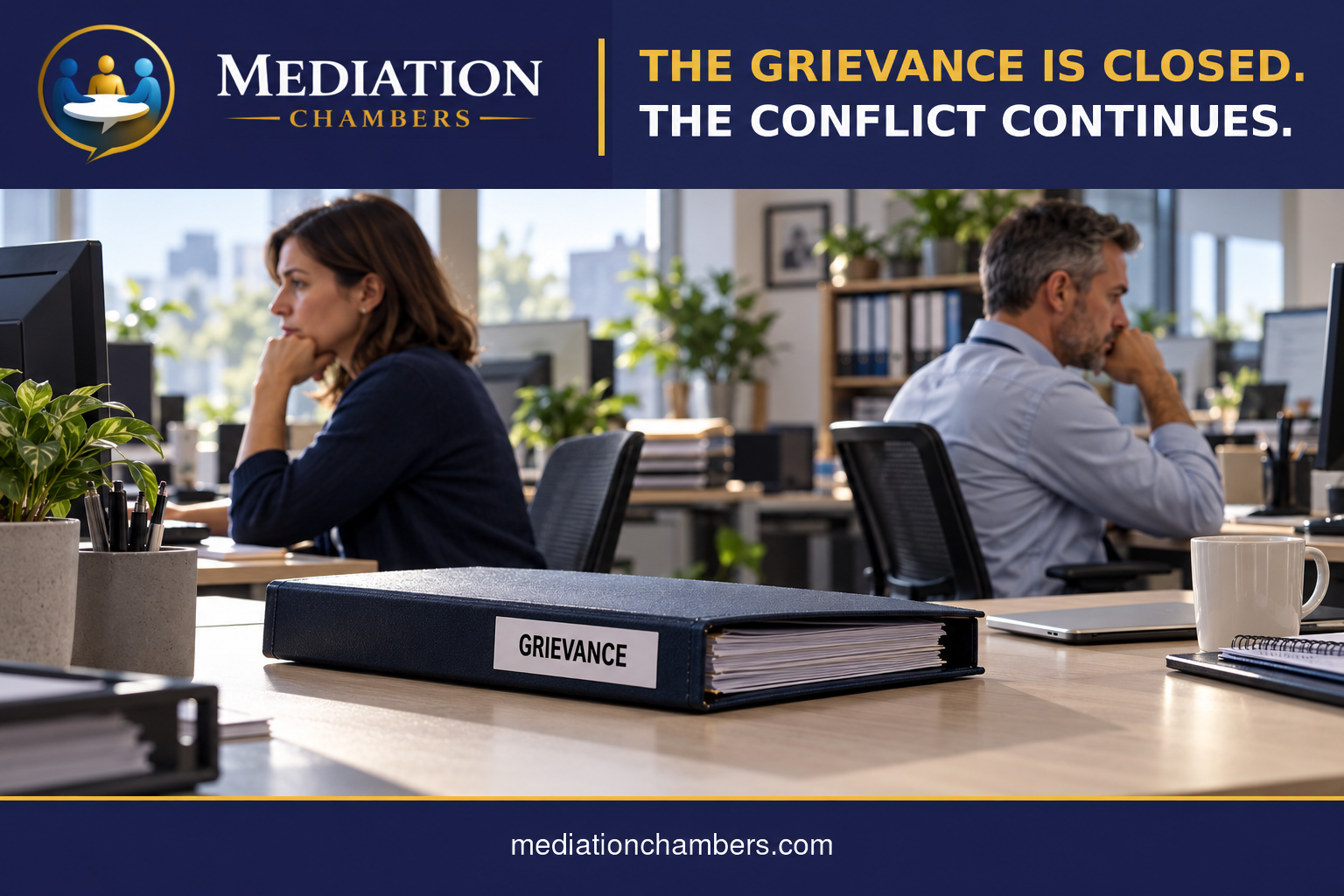
A fair grievance procedure establishes findings and allows the employer to decide what action is appropriate. The organisation also needs to consider how work will function afterwards. Closing the file does not settle that question.
The outcome letter has been sent. The appeal has finished. HR records the grievance as closed. On Monday morning, the same people still have to work together.
They may now avoid direct conversations, copy managers into routine emails and question decisions they previously accepted. Colleagues carry messages between them. Work continues, but with more effort and less confidence.
For employers, the practical challenge is to preserve the integrity of the decision while addressing the working conditions and relationships that remain. This article concerns workplace practice in Great Britain.
The outcome can mean different things to the people receiving it
A grievance may be upheld, partly upheld or not upheld. Each result can leave a different difficulty behind.
Where a complaint is upheld, the employee may expect an apology, protection from a repeat incident or visible change. The person complained about may feel exposed or resentful. Necessary organisational action can follow, yet neither person may know how ordinary contact should resume.
Where a complaint is not upheld, the employee may still believe the experience was damaging. The decision may reflect insufficient evidence or a finding that the particular allegation was not established. It should be read according to its actual wording. Treating every unsuccessful grievance as proof that the employee invented the problem goes beyond what the findings may support.
The person complained about has legitimate interests too. They may want their reputation protected, reassurance about their authority and an end to repeated allegations. They should not be expected to confess to conduct the investigation did not establish as a condition of improving the relationship.
A partly upheld grievance can be especially difficult. Each participant may focus on the part that supports their own account. The employer needs to explain what was decided, implement the required action and identify the practical issues that the decision leaves open.
Acas guidance on deciding a grievance outcome recommends a written decision and a right of appeal. It also recommends a private conversation with the employee where no action is considered necessary. The outcome letter is one part of the employer's response.
The evidence gives employers a reason to look beyond procedural closure
The Acas research published in November 2025 surveyed 4,558 working-age people in Great Britain. Among respondents who reported conflict, half said it was largely or fully resolved, while 31% said it was mainly or completely unresolved. Only 9% reported using a formal grievance or complaints procedure.
These figures describe workplace conflict broadly, including difficult relationships and disputes with customers. They do not measure how often completed grievance procedures fail, or show that formal procedures caused continuing conflict. They do support a more careful question: what evidence tells the employer that the underlying difficulty has improved?
That question is also timely. Acas's consultation on a revised disciplinary and grievance Code closed on 23 September 2026. As at 30 October, Acas was reviewing responses. The proposals emphasise early resolution; they should not be presented as an already operative replacement for the existing Code.
Employers do not need to wait for a revised Code to examine what happens after a case closes.
The next dispute can develop through ordinary working decisions
Consider a composite example, rather than a reported case. An operations coordinator complains that her supervisor gives preferred shifts and opportunities to other colleagues. The investigation does not uphold the allegation of deliberate favouritism, but finds inconsistent communication about rota changes. The employer introduces a clearer notification process.
The supervisor understands the main finding as vindication. The coordinator sees the communication finding as recognition that something was wrong. Both return to work believing the other has failed to acknowledge the outcome properly.
The supervisor starts communicating almost entirely by email to avoid further accusations. The coordinator interprets the change as punishment for raising the grievance. She asks a colleague to pass on a scheduling question. The colleague checks with another manager before approaching the supervisor. A routine issue now involves four people.
Nobody has agreed how questions should be raised, how decisions will be explained or who should intervene if contact becomes strained. The improved rota policy addresses a genuine problem, but everyday cooperation remains fragile.
The sequence is illustrative, not inevitable. It shows how a second dispute can grow around the response to the first. Attempts at self-protection become evidence, in the other person's mind, that the hostility continues.
Colleagues and customers can end up paying for the unresolved relationship
The cost of continuing conflict may appear in small operational changes before it appears in another complaint.
Handover information arrives late because two people avoid speaking. A manager attends meetings that previously needed no supervision. Tasks are duplicated because neither participant trusts the other's work. A capable colleague quietly becomes the intermediary and loses time from their own responsibilities.
These arrangements can become normal. The organisation adapts around the conflict, making it harder to see how much work it creates. A team may appear stable only because everybody knows which subjects to avoid and which people cannot be put together.
There are consequences for the participants as well. One may stop volunteering for projects. Another may seek a transfer or begin looking elsewhere. A manager who feels unable to give ordinary feedback may allow performance concerns to accumulate. The employee then faces a more serious conversation later, with less opportunity to address the issue early.
Employers can examine their own management hours, disrupted work and departure patterns. These indicators do not prove that an unresolved grievance caused each cost. They help identify where a completed procedure has left a continuing operational problem.
Health concerns also require appropriate support. HSE's Relationships standard includes positive working, sharing relevant information and systems for responding to unacceptable behaviour. A team that has learned to function through avoidance deserves attention even when nobody has submitted another form.
New treatment must be assessed on its own merits
After a grievance, ordinary management can become more difficult. A supervisor may fear that any correction will be called retaliation. An employee may interpret a changed assignment as evidence that complaining has damaged their prospects.
The employer should examine the reasons for decisions and how they are applied. Legitimate performance management remains necessary. Equally, the existence of a concluded grievance does not excuse exclusion, hostility or a disadvantage imposed because someone raised a concern.
There is a specific legal distinction where discrimination law is involved. Acas explains victimisation as suffering a detriment because of a protected act, or a belief that someone has done or may do one. Making or supporting a discrimination complaint can be a protected act. A complaint need not succeed to attract protection; deliberately false allegations raise different issues.
Every disagreement following a grievance is not automatically victimisation under the Equality Act. The reason for the treatment and the nature of the complaint matter. Other protections may also apply depending on the circumstances. Employers should seek appropriate advice rather than use the word loosely or dismiss the possibility without investigation.
If a fresh allegation requires determination, it needs a proper response. Asking people to improve their relationship must not become a condition of having serious concerns heard.
Employers need a plan for the work that follows the decision
There is a reasonable objection to further intervention: the organisation has already spent time investigating, reached a fair conclusion and provided an appeal. Repeatedly revisiting the same allegations can undermine finality and leave the person complained about in permanent uncertainty.
That objection deserves respect. A useful follow-up establishes how work will operate within the decision already made. It also distinguishes disagreement with the findings from a new concern, an implementation failure or a damaged relationship.
The employer should appoint someone with enough authority and sufficient distance from the dispute to oversee the next steps. In a small business that may require external HR or other support. Where the line manager was a participant, giving them sole responsibility for assessing whether the relationship has recovered is unlikely to inspire confidence.
The following checks offer a practical starting point. They are recommendations, to be adapted to the organisation and case.
| Matter | Practical check | Responsibility |
|---|---|---|
| Decision | Are the outcome and any appeal position understood? | Decision-maker or HR |
| Implementation | Has each required action been assigned and completed? | Manager with authority to deliver it |
| Everyday work | Are contact, feedback and handovers workable? | Relevant manager and participants |
| Wider team | Are colleagues carrying messages or losing information? | Team manager |
| Review | Who will check progress and respond to renewed concerns? | Named person outside the immediate dispute where possible |
Private conversations can establish what each participant needs to carry out their role properly. They should be asked about specific working arrangements, rather than required to endorse the investigation or promise to feel differently.
If the real obstacle is conflicting instructions, excessive workload or unclear authority, management must change those conditions. Two employees cannot resolve an organisational contradiction by agreeing to communicate more pleasantly.
Confidentiality should support a workable return to ordinary work
The wider team usually needs much less information than the participants. It may need to know that a process has finished, how responsibilities will now operate and where concerns should be raised. It does not need access to personal evidence or a running account of who said what.
Acas guidance on the period after a grievance recommends keeping details confidential, speaking privately with directly involved staff where appropriate and explaining relevant changes. That gives employers a useful basis for limiting gossip without leaving an operational vacuum.
Confidentiality must also allow people to obtain appropriate advice and representation and exercise their legal rights. A general instruction to “tell nobody” can create confusion about legitimate support. The employer should explain the boundary accurately.
A team can receive a clear instruction about a new handover process without being told why one participant was distressed or what another said in an interview. Necessary implementation and unnecessary disclosure are different decisions.
Mediation can help establish how people will work together
Acas expressly recognises mediation as an option for rebuilding relationships after a disciplinary or grievance process. Its purpose is to help participants explore a workable way forward with an impartial mediator.
In the composite example, useful questions might concern how rota queries will be answered, what requires a meeting, when a third person should become involved and how an urgent issue will be handled. The supervisor can explain the pressure they now feel when managing. The coordinator can explain why the change in contact has felt excluding. Hearing those accounts does not require the mediator to overturn the findings.
Practical agreements need enough detail to be usable. “We will communicate better” leaves both people free to believe the other has broken the promise. Agreement on a weekly planning conversation, a shared record of rota changes and an escalation route gives them something clearer to try.
Workplace mediation is voluntary. The people involved should understand its purpose and have a genuine choice about participation. An invitation is less credible if it is presented as an opportunity to admit fault or as a test of loyalty to the employer.
Independence matters particularly where the internal advisers have already been involved in the case. Acas's guidance on introducing mediation identifies conflicts of interest, sensitive situations and senior-management disputes as reasons to consider external provision. Choosing a mediator should address the participants' confidence in the process, as well as availability and cost.
Preparation should establish suitability, accessibility and any imbalance of power. Serious misconduct, discrimination or safeguarding issues may still require investigation and action. Participants should not be expected to bargain away necessary protection. Findings that require organisational action remain the employer's responsibility.
The mediation agreement should explain confidentiality and applicable exceptions, together with what the participants authorise to be shared for implementation. Management needs to know what it must deliver, without receiving a report of the private discussions. Workplace mediation agreements about behaviour are also different from legal settlement agreements disposing of employment claims.
Internal appeals and legal deadlines require separate attention. Acas warns that grievance, disciplinary and appeal procedures do not alter employment tribunal time limits. A workplace mediation meeting should not be assumed to pause a deadline or replace Acas early conciliation.
The review should look for reliable cooperation
The objective need not be friendship or agreement about every past event. Reliable professional cooperation may be a sufficient and realistic outcome.
For example, the employer might arrange a short review after two weeks and a fuller review after six. Those intervals are illustrative, not a prescribed timetable. The review should ask whether information is reaching the right people, agreed meetings are happening and participants can raise a problem without restarting the entire dispute.
A reduction in complaints alone is weak evidence. Someone may have stopped complaining because they have lost confidence in the process. Specific evidence of improved work, considered alongside private feedback and any continuing concerns, gives a better picture.
If an arrangement fails, examine why. A promise may depend on authority or resources the participants do not have. Further management action, training, changed responsibilities or formal procedures may be necessary. Transfer or separation should be assessed fairly, with proper attention to rights and consequences, rather than used automatically to move the complainant out of the way.
The grievance decision remains important. Its value is strengthened when the organisation also takes responsibility for what happens next. A case can be administratively complete while the people and the work still need attention.
Questions for leaders
- What tells us that a closed grievance has led to a workable situation?
- Who owns the follow-up when the line manager was involved in the dispute?
- Have the actions promised in the outcome actually been delivered?
- Are colleagues compensating for a relationship that remains difficult?
- Can we protect the finality of the decision while addressing new conduct and practical problems?
- What would reliable cooperation look like in this particular team?
Frequently Asked Questions
Does mediation after a grievance reopen the decision?
It should have a clearly agreed purpose. Mediation can address how people will work together while preserving the findings and any required organisational action. It does not act as an appeal or give the mediator authority to reverse the employer's decision. A challenge to the findings belongs in the appropriate appeal process. A new allegation may require investigation. Agreeing the scope before mediation helps participants understand what they are being invited to discuss and what remains for management or another procedure.
Does an unsuccessful grievance mean the complaint was false?
That conclusion should not be drawn automatically. An allegation may not have been established on the available evidence, or the investigation may have reached a particular finding about what happened. The actual reasons matter. A finding that a complaint was deliberately fabricated is a separate issue and requires proper consideration. Employers should explain their decision accurately and avoid allowing either participant to turn a limited finding into a wider judgment about the other's character or motives.
Can an employee be required to take part in workplace mediation?
Workplace mediation is voluntary. Employers can explain the process, address concerns and offer appropriate support, but should preserve a genuine choice about taking part. A refusal does not remove the employer's responsibility to manage the working situation or investigate matters requiring a decision. Equally, agreeing to mediation does not require accepting terms or admitting wrongdoing. Managers still need clear expectations for lawful and professional conduct, whether or not mediation takes place or produces agreement.
What should colleagues be told after a grievance?
Share what is necessary for them to carry out their work and understand relevant changes. Directly involved staff may need a private explanation that the process has concluded and a reminder about confidentiality. The wider team may need updated responsibilities or communication arrangements. That does not justify circulating personal evidence or disciplinary information. Explain where concerns can be raised and preserve access to appropriate advice, representation and legal rights. A limited, accurate explanation can reduce uncertainty without disclosing the case.
What happens if mediation does not produce an agreement?
The employer still needs to address the working arrangements, implement the grievance outcome and respond to any continuing concerns. Depending on the issue, further discussion, training, changes to work or an appropriate formal procedure may be required. There should be no assumption that the absence of agreement proves either participant was at fault. Confidentiality must be respected in accordance with the mediation agreement and applicable exceptions. Participants and the employer should be clear about the next available steps before the process begins.
How can an employer tell whether the situation has improved?
Look for changes in everyday work as well as the participants' accounts. Are handovers reliable, meetings taking place and decisions being explained through the agreed route? Are colleagues still acting as intermediaries? Have required organisational changes been completed? Review these matters at agreed intervals and provide a way to raise renewed concerns. Silence alone is not evidence of resolution, and an initial agreement is not proof of lasting improvement. The aim is sustainable, professional cooperation supported by appropriate management.
Discuss Your Dispute
A brief, confidential initial conversation to understand whether mediation may assist.
Get in TouchMore Insights
- When Conflict Makes People Ill, Who Deals With the Cause?
- Why Many Employment Tribunal Claims Never Reach a Full Hearing
- When Trust Breaks Down Between School Leaders and Staff
- AI May Spare Junior Jobs. It Could Still Break the Leadership Pipeline.
- Schools Under Pressure and the Cost of Unresolved Conflict
- Inheritance Disputes: When Family Expectations Collide
- All Articles →