Insights
When Trust Breaks Down Between School Leaders and Staff
November 2026
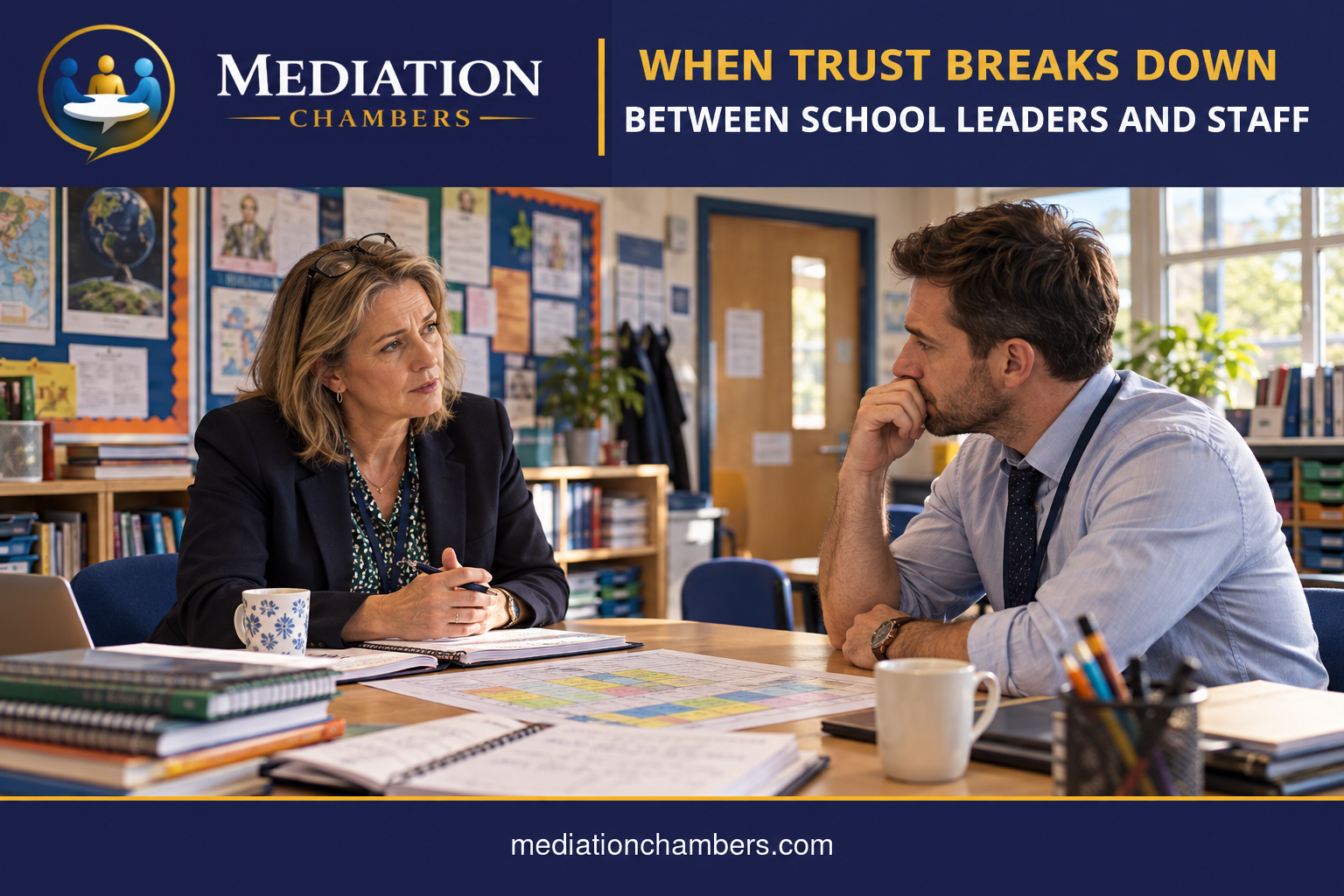
Schools need leaders who can set standards and staff who can raise concerns without being treated as disloyal. When trust deteriorates, both become harder.
A discussion about lesson observations becomes an argument about professional respect. A request to reduce workload is heard as resistance to change. A headteacher begins to see a colleague as obstructive; the colleague begins to see every management decision as evidence that they are being pushed out.
The school day continues. Lessons are taught, cover is arranged and meetings take place. The adults may nevertheless be spending increasing amounts of their time protecting themselves from one another.
The challenge is to identify what needs a management decision, what requires formal protection and what might benefit from an independent conversation. This article principally concerns schools in England. It draws on two published court and tribunal cases and a named school mediation example, with sources checked on 2 November 2026.
Professional disagreement can become a test of loyalty
There are sound reasons for a headteacher to change established practice. Inconsistent assessment, weak teaching or unclear responsibilities can require intervention. Long service does not make a colleague exempt from reasonable expectations, and a disagreement does not automatically make a management decision improper.
Staff may also have sound reasons for questioning a proposal. A new recording system may duplicate existing work. A timetable change may affect specialist provision. An observation arrangement may depart from an agreed protocol. A teaching assistant may be expected to carry responsibilities without adequate support.
The dispute changes character when the discussion moves from the proposal to the person's supposed motives. “Will this improve learning?” becomes “Why are you always negative?” A request for clarification becomes a challenge to authority. Staff then become more cautious about speaking, while leaders receive less useful information about the effects of their decisions.
The Department for Education's Headteachers' Standards combine school improvement with positive relationships and staff development. They are non-statutory guidance, interpreted in the context of the school. Their breadth matters: maintaining professional relationships is part of leadership alongside improving standards.
Friars Primary School shows the risk of treating representation as opposition
In Wood-Hope v Salford City Council and the Governors of Friars Primary School, the claimant was a teacher and National Education Union representative. The published tribunal judgment describes a dispute over changes to the classroom observation protocol. Staff concerns were raised through the union representative, and the tribunal found that an informal warning was given in response to her carrying out that role.
The tribunal ultimately found automatic unfair dismissal for trade union reasons, trade union detriment and unlawful disability discrimination. These were findings about this case, rather than an assumption that every disagreement over observations is unlawful.
The later remedy reasons recorded a total award of £370,563.53, including tax grossing-up and a 15% Acas uplift. They also criticised the governing body's failure to hold the headteacher to account when considering the grievance.
The lesson for schools is that a disagreement with a representative must be examined in its proper context. Governors and trust leaders need to test the evidence and the process, including when the concern is about the person who normally advises them. Confidence in a headteacher should support scrutiny rather than displace it.
Mediation cannot retrospectively make unlawful treatment acceptable. Nor does this case establish that mediation would have prevented the outcome. It does show why early concerns should not be allowed to harden into a campaign against the person raising them.
A workload problem needs a workload response
Some disputes become personal because the underlying problem is repeatedly left unresolved. A member of staff asks for help, receives a sympathetic conversation and returns to the same demands. By the next meeting, they may be angry. The employer then focuses on the anger and loses sight of the original request.
Barber v Somerset County Council, decided by the House of Lords in 2004, concerned a teacher at East Bridgwater Community School who developed serious psychiatric illness. Following restructuring, he had taken on additional responsibilities. He had been absent with stress and depression and told senior colleagues that he could not cope with his workload.
The House of Lords restored the finding in his favour, with damages in a reduced agreed amount. Lord Walker explained that management should have made inquiries and considered steps to ease the situation, rather than simply telling him to prioritise. The school's wider pressures did not remove the need to respond to the particular warning signs.
This was a duty-of-care case, not a mediation case. Its relevance is the boundary it establishes for the article's argument. A useful conversation may help clarify workload and damaged trust, but it cannot make an unsustainable allocation of work sustainable. Health support, adjustments and changes to duties may be necessary alongside any attempt to repair a relationship.
The current HSE Relationships standard similarly connects positive working with systems for responding to unacceptable behaviour and sharing information. Staff wellbeing needs attention in the way work is organised and managed.
Conflict rarely stays between the original two people
School working relationships are unusually interdependent. A disagreement between a head of department and a senior leader can affect assessment, examination entries, resource decisions and support for less experienced teachers. A dispute involving a teaching assistant can affect the teacher they support and the consistency available to pupils.
Colleagues may begin carrying messages. Meetings become longer because routine decisions require another person present. Staff avoid joint planning or stop asking for feedback. A temporary change in duties may protect someone from immediate contact while placing extra work on the people around them.
The cost can therefore arrive through several routes: cover, management time, delayed work and the loss of an experienced colleague. A replacement may bring valuable new expertise, but the school still has to recruit, induct and support them. In a small department, losing one specialist can have consequences that are difficult to absorb through the existing timetable.
This is not an argument for retaining every member of staff regardless of performance or conduct. It is a reason to establish whether the school is losing someone because a necessary decision has been made fairly, or because an addressable relationship problem has consumed the capacity to work together.
The distinction applies to leaders too. A headteacher facing entrenched opposition, personal attacks or repeated allegations needs support and fair treatment. Independent help should make it possible to examine the problem without deciding in advance which role deserves sympathy.
Walton Multi Academy Trust provides a practical mediation example
A published Capita Entrust case study concerning Walton Multi Academy Trust describes a working relationship between two employees that had come under severe strain. The trust commissioned face-to-face mediation.
The provider reports that preparation included a discussion with leadership and separate meetings with the employees. Those meetings explained the process, checked voluntary participation and allowed each person to describe their experience. A joint session followed, and the agreed way forward was recorded in writing. The trust's Chief Financial and Operations Officer reported that the colleagues were working positively together again.
This is the provider's own account, supported by a named client testimonial. It is not an independent evaluation, and it does not establish a sector-wide success rate or show that the same approach will suit every dispute. It nevertheless gives a concrete example of a school trust addressing a damaged relationship through preparation and structured discussion.
The account does not identify the employees' roles, so it should not be described as a headteacher–teacher dispute.
Leaders need to choose the right response before positions harden
A school does not need to choose one route for every aspect of a difficult situation. It needs to understand which issue each route can properly address.
| Issue requiring attention | Appropriate response | Possible role for mediation |
|---|---|---|
| Unclear responsibilities or conflicting instructions | Management clarifies authority and expectations | Help participants agree how those arrangements will work |
| Workload affecting health | Assess risks, support health and consider changes to work | Explore communication and cooperation alongside action |
| A contested organisational change | Relevant consultation, representation and decision-making | Support dialogue where agreed and suitable |
| Serious allegations or safeguarding concerns | Required reporting, investigation and protective action | Consider separate relationship issues only where appropriate |
| Damaged trust between people who must continue working together | Fair management and an assessment of what has broken down | An independent, voluntary discussion about a workable future |
The table is a practical distinction, rather than a substitute for the school's policies or advice on a particular case. Where children may be at risk, the school must follow the applicable safeguarding arrangements. Keeping Children Safe in Education provides the statutory framework in England. A confidential meeting cannot replace required action.
Equally, concerns about discrimination, trade union treatment or serious misconduct should not be relabelled as a personality clash to avoid examination. Mediation is useful only when its purpose and limits are understood.
There is a responsibility on staff as well. Professional disagreement does not justify intimidation, obstructing reasonable work or making personal attacks. Leaders should address behaviour fairly and consistently while leaving room for legitimate challenge.
Independence matters when the dispute involves the leadership
In a school, it can be difficult to find someone sufficiently removed from the disagreement. A deputy may have implemented the disputed policy. HR may have advised on it. A governor may already have heard one side informally. Colleagues may be expected to work with everyone involved long after the discussion ends.
An internal person can act fairly and still struggle to be perceived as independent. Acas guidance on introducing mediation identifies conflicts of interest, senior-management disputes and sensitive situations as reasons to consider external provision.
The commissioner also needs clarity about authority. In a maintained school, academy trust or independent school, different people may hold responsibility for employment decisions and expenditure. A mediator cannot promise a reporting-line change, additional staffing or a revised policy on behalf of someone who has not authorised it.
Before commissioning, the school should identify who can approve any organisational action and how they will be involved. The participants need to know what they can agree themselves and what must be referred back for a decision.
Staff representatives can help members understand their options and prepare. Their role should be discussed in advance so that support strengthens the participant's ability to speak and decide. It should not turn the meeting into another exchange conducted entirely through representatives.
A useful mediation needs to reach everyday school practice
Acas describes workplace mediation as a voluntary process in which an impartial person helps participants explore an agreed way forward. It can address relationship breakdown and communication difficulties. The mediator does not determine who should win an employment claim or replace a decision about conduct.
In a school leadership dispute, the useful detail may concern how feedback will be given, how concerns about workload will be raised and when a disagreement needs to go beyond the line manager. Participants may need to examine how professional challenge became a personal threat and what would make it possible to discuss an issue directly again.
Agreement should be specific enough to use. A scheduled planning conversation, a clear route for querying an observation record or an agreed review of responsibilities gives people something to work with. A general promise to show mutual respect is harder to assess when the same words and decisions are already understood differently.
Preparation should consider accessibility, health, power differences and whether each person feels able to participate freely. A mediation appointment should not be presented as a requirement to admit fault, withdraw a legitimate concern or accept equal responsibility for everything that happened.
The school can receive brief confirmation that mediation occurred and whether a settlement was agreed. Private discussions and detailed terms should be handled under the mediation arrangements and applicable legal obligations. Any operational action requiring the school to deliver something must be communicated through an appropriate agreed route.
Participation does not by itself suspend formal rights or deadlines. The school and participants should obtain advice where an appeal, employment claim or another procedure remains relevant.
The school needs to check whether working together has become possible
The point of intervention is to improve what happens back at school. A signed agreement may provide a useful start, but the test comes when the next timetable decision, observation or difficult pupil issue arises.
Leaders should check whether agreed arrangements have been implemented and whether people can raise ordinary questions without restarting the dispute. Are staff receiving the information they need? Are colleagues still acting as intermediaries? Has management delivered the change in work that was promised?
Those checks should be proportionate and respect the confidentiality of the process. Reviewing implementation is different from asking the mediator to report on what each participant said or whether they appeared sufficiently cooperative.
Some situations will require further management action. Some relationships will not recover. The value of early intervention is that it gives the school a better opportunity to understand the problem and preserve workable options before absence, formal conflict or departure narrows them.
Schools depend on adults exercising professional judgment together. Protecting that capacity requires clear standards, fair accountability and a credible way to address relationships when trust has broken down.
Questions for leaders
- Can staff question a proposal without the discussion becoming a test of loyalty?
- Are we dealing with a relationship problem, a workload problem or an allegation that requires investigation?
- Who can challenge the account when the concern involves the headteacher or another senior leader?
- Are colleagues and pupils experiencing the effects of a dispute we still describe as being between two people?
- What would the participants need to agree for ordinary professional conversations to become possible again?
- Who has the authority to deliver any organisational changes arising from the discussion?
Sources
- Employment Tribunal, Wood-Hope v Salford City Council and the Governors of Friars Primary School, 2408035/2021, reserved liability judgment, 2024; liability judgment sent to the parties 18 March 2024.
- Employment Tribunal, Wood-Hope remedy reasons, dated 28 April 2025, sent 6 May 2025, particularly paragraphs 51–64.
- House of Lords, Barber v Somerset County Council, facts, 1 April 2004, [2004] UKHL 13, particularly paragraphs 37–53.
- House of Lords, Barber judgment continued, 1 April 2004, particularly paragraphs 64–71.
- Capita Entrust, Walton Multi Academy Trust mediation case study, provider account and named client testimonial, undated.
- Department for Education, Headteachers' Standards 2020, 2020.
- Health and Safety Executive, Management Standards: Relationships.
- Department for Education, Keeping Children Safe in Education, September 2026 edition.
- Acas, What mediation is and how it can help, updated 18 October 2022.
- Acas, Introducing mediation at work, updated 18 October 2022.
Frequently Asked Questions
Can mediation help with a dispute between a headteacher and a teacher?
It may help where trust or communication has broken down and the participants need to explore how they can work together. The purpose should be clear, participation voluntary and the mediator impartial. Preparation must consider the difference in organisational power, any health concerns and what each person can actually agree. Necessary management decisions, safeguarding action and formal investigations remain separate responsibilities. An independent discussion can be useful without requiring either participant to accept the other's account of every past event.
Does mediation undermine a headteacher's authority?
It should clarify how authority and professional challenge will operate. A headteacher retains the responsibility to lead the school, and staff retain their rights and professional responsibilities. The mediator cannot promise policy changes or remove legitimate standards. Participants may agree better arrangements for feedback, raising concerns and handling disagreements. Any proposed organisational change needs approval from the person or body with authority to make it. Clear expectations can support leadership while reducing the uncertainty that allows ordinary decisions to become personal disputes.
Are the examples in this article real cases?
Yes. Wood-Hope concerns published employment tribunal findings involving Friars Primary School. Barber is a House of Lords decision about a teacher's work-related psychiatric illness. The Walton Multi Academy Trust example comes from a named provider's published mediation account and client testimonial. The court cases were not presented as mediation successes, and the provider's account is not an independent evaluation. Each example supports a different point about rights, management responsibility or the practical use of mediation.
Should a school try mediation before investigating a serious concern?
The school must first identify what action the concern requires under applicable law, safeguarding guidance and its procedures. Mediation cannot replace required reporting, establish whether a serious allegation is true or remove necessary protection. It may sometimes address a distinct relationship issue once its scope and timing are appropriate. A person should not have to accept mediation to have a legitimate concern examined. Where the position is unclear, the school should obtain advice before deciding how the different processes will operate.
Can teaching assistants and other support staff use mediation?
Yes, where it is suitable for the issue. School conflict can involve teaching assistants, administrative teams, premises staff and business professionals as well as teachers and leaders. Consider the actual reporting relationship, working arrangements and support needed for effective participation. A disagreement over communication may be suitable for mediation, while a question about pay entitlement, staffing capacity or serious conduct may require a different response. The process should give each participant a meaningful opportunity to speak and make decisions.
What should governors or trust leaders do if the headteacher is involved?
Follow the applicable governance arrangements and grievance or other relevant procedure. Identify conflicts of interest and ensure that the concern receives proper scrutiny. Governors or trust leaders may need independent advice or support, particularly if they have already been involved in the events. If mediation is suitable, someone with the necessary authority should commission it and approve any organisational action. Supporting the headteacher and holding leadership to account are compatible responsibilities; neither should prevent a fair examination of staff concerns.
Discuss Your Dispute
A brief, confidential initial conversation to understand whether mediation may assist.
Get in TouchMore Insights
- The Grievance Is Closed. The Conflict Continues.
- When Conflict Makes People Ill, Who Deals With the Cause?
- Why Many Employment Tribunal Claims Never Reach a Full Hearing
- Schools Under Pressure and the Cost of Unresolved Conflict
- AI May Spare Junior Jobs. It Could Still Break the Leadership Pipeline.
- Inheritance Disputes: When Family Expectations Collide
- All Articles →