Insights
Inheritance Disputes: When Family Expectations Collide
October 2026
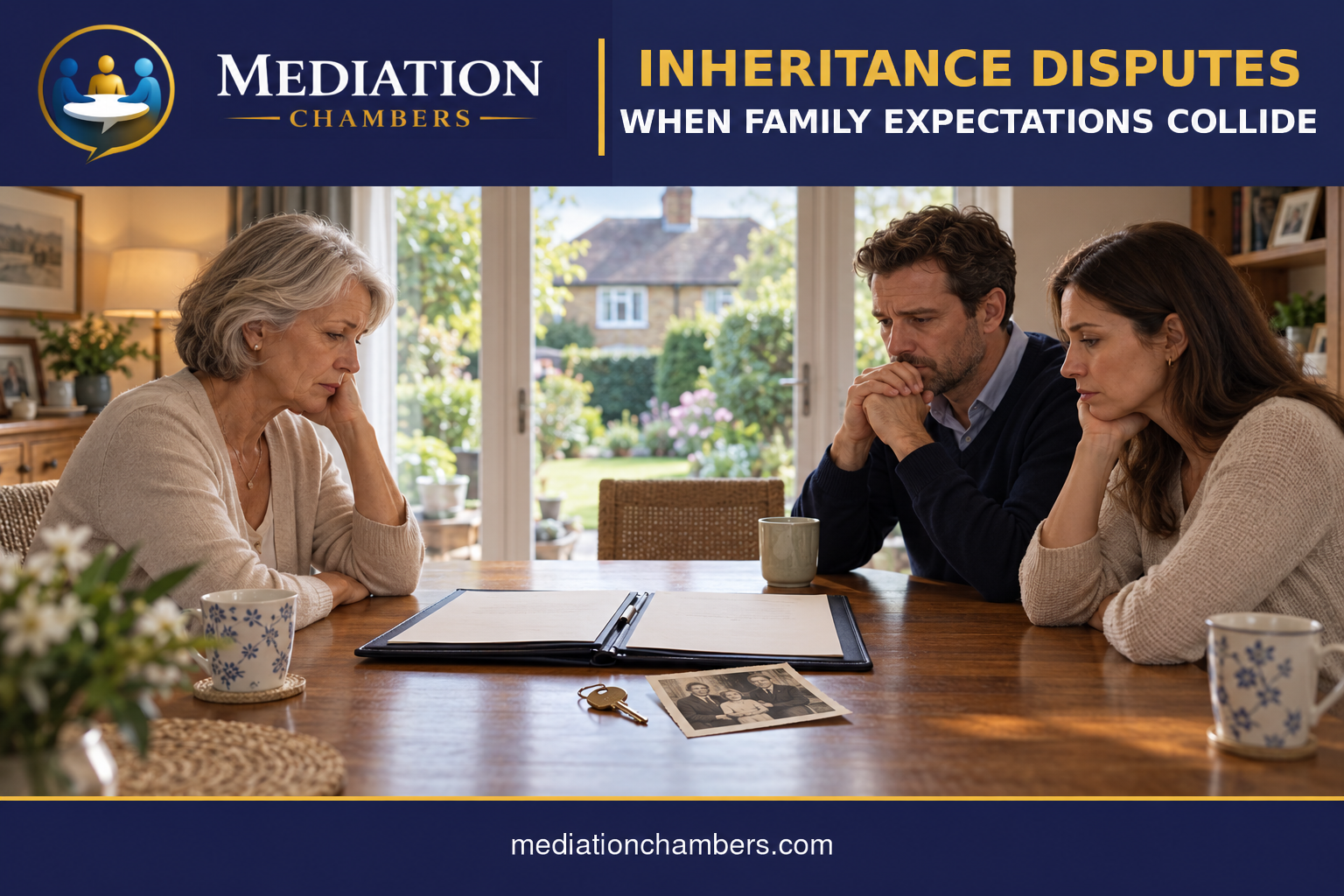
A surviving partner may be trying to keep their home. Children from an earlier relationship may be trying to protect what they believe their parent intended them to inherit. Each can see the other's position as a threat, even before anyone has established what the estate contains or what the law permits.
Inheritance disputes bring grief, financial need and family history into the same negotiation. A disagreement over a house or a will can become an argument about who mattered, who gave up most and who has been excluded. The consequences reach beyond the assets being divided.
This article considers England and Wales, with the legal position checked on 5 October 2026. Scotland, Northern Ireland and estates involving overseas assets require separate analysis. The purpose is to explain how conflict develops and what deserves attention before it becomes a prolonged dispute.
A death can expose disagreements that were never settled
Families often postpone difficult conversations about money. Parents may tell different children different things, assume that everyone understands their intentions, or expect a surviving partner to look after the next generation without recording how that should happen.
Those arrangements may function while the parent can explain a decision. After death, the person whose intentions matter most cannot clarify an ambiguous promise or contradict an accusation. Family members reconstruct the explanation from documents, remembered conversations and their own experience of the relationship.
Equal treatment also means different things to different people. One child may have received help buying a home. Another may have provided years of care. A third may have worked in the family business for modest pay. Dividing the remaining estate equally can look fair to one person and ignore a substantial contribution in another's eyes.
These are mechanisms by which conflict can develop, not evidence that every unequal distribution is wrong. A person may have sound reasons for an unequal will. Nor does providing care automatically create an entitlement to an additional inheritance. The difficulty is that an unexplained decision leaves relatives arguing over both the money and its meaning.
Cohabiting partners and children may face sharply different outcomes
Consider an illustrative family, not a reported case. Martin and Helen have lived together for eighteen years without marrying or entering a civil partnership. Martin has two adult children from an earlier relationship. Helen sees their home as the centre of the life they built together. His children understand that their father wanted them eventually to inherit it.
Martin dies. The outcome cannot be determined simply by asking who was closest to him. The will, ownership arrangements, family circumstances and any valid claims all matter.
Under the current law, a cohabiting partner has no automatic inheritance entitlement under intestacy, however long the relationship lasted. Living together does not create a marriage. A legally registered civil partner has a different status. The Ministry of Justice's 2026 consultation on relationship law acknowledges this gap and proposes reform. Those proposals should not be treated as rights already in force.
If Martin dies without a valid will, has no surviving spouse or civil partner, and the two children are his only descendants, they would ordinarily inherit his net estate under the intestacy rules, subject to any successful claims. Helen's length of cohabitation does not itself give her an intestacy share. The Government Legal Department's guidance sets out the hierarchy of entitled relatives.
That is not necessarily the same as saying Helen receives nothing. She may already own assets herself or have an interest in jointly owned property. She may also be eligible to seek financial provision. These possibilities need to be examined separately.
| Circumstance | Starting position | Potential point of conflict |
|---|---|---|
| No valid will and no surviving spouse or civil partner | Intestacy determines which relatives inherit | A cohabiting partner may be excluded from the estate distribution |
| A valid will leaves the estate to the partner | The will identifies the beneficiaries | Children may question validity or seek financial provision if eligible |
| A valid will leaves the estate to the children | The children are the named beneficiaries | The partner may seek financial provision or assert existing property rights |
| The home is owned as beneficial joint tenants | The deceased's interest ordinarily passes to the surviving owner | Children may discover that the home does not pass under the will |
| The home is owned as tenants in common | The deceased's share falls to be dealt with through their estate | The survivor and beneficiaries may disagree over occupation or sale |
The property distinction is particularly important. GOV.UK's joint-ownership guidance explains that beneficial joint tenancy and tenancy in common have different consequences on death. A will cannot simply dispose of an interest that passes by survivorship. Equally, a survivor who already owns a share of the home does not lose that share merely because the other owner's children inherit the deceased's interest.
If Martin was still legally married to someone else, that changes the analysis again. A long separation is not a divorce. Families need an accurate account of legal status rather than assumptions about which relationship felt most significant.
Being eligible to claim does not guarantee an inheritance
The Inheritance (Provision for Family and Dependants) Act 1975 allows specified applicants to seek reasonable financial provision where the deceased was domiciled in England and Wales. An eligible cohabitant generally needs to have lived in the same household as the deceased, as a married couple or civil partners, throughout the two years immediately before death. A person maintained by the deceased may qualify through a separate route.
Helen might therefore have a claim even if Martin's children inherit under intestacy. Conversely, leaving everything to Helen in a valid will does not necessarily remove the children's ability to apply. A child of the deceased, including an adult child from an earlier relationship, is within the statutory categories. Eligibility opens the door to an assessment; it does not determine the result.
Whose children they are also matters. Helen's children from her own earlier relationship would not automatically inherit Martin's estate under intestacy merely because they lived as a family. Legal adoption changes the position. Someone treated by Martin as a child of the family may be eligible to seek financial provision even without an automatic intestacy share. "The children" is too imprecise a description for estate planning.
The statutory assessment considers matters including the applicant's resources and needs, the beneficiaries' circumstances, the deceased's obligations, the size and nature of the estate and disability. In a blended family, the survivor's housing needs may compete with a child's financial needs. An estate consisting mainly of one property offers limited room to meet both immediately.
The standard for a spouse or civil partner is generally broader than the maintenance-based standard applying to cohabitants and children. A claim by an adult child is not a general right to an equal share or an invitation to rewrite a will simply because it feels unfair.
In Ilott v The Blue Cross and others, decided in 2017, an estranged adult daughter sought financial provision after her mother left most of her estate to charities. The Supreme Court restored the original £50,000 award, reversing the Court of Appeal's larger provision. The case illustrates the balance between testamentary freedom and statutory provision. It supplies no universal entitlement for an excluded child, and an award in one family's circumstances is not a tariff for another.
The family implications are substantial. Helen may experience the children's position as an attempt to displace her. The children may experience her claim as an attempt to consume an inheritance that will never reach them. Neither interpretation establishes the legal merits. Recognising the different fears can, however, make a practical discussion possible.
Unmarried people without a partner can leave a different mismatch
Someone who is unmarried, has no civil partner and dies without a valid will may have an estate passing to children or, if there are none, through the prescribed hierarchy of other relatives. A close friend who provided daily care may receive nothing under those rules, while a relative with little recent contact may be entitled to inherit.
The intestacy hierarchy reflects recognised legal relationships, rather than measuring affection or practical support. Where there are no entitled relatives and no effective will, an estate may become ownerless property, known as bona vacantia, dealt with by the Crown or the relevant Duchy. Friendship alone does not create an intestacy entitlement.
For an unmarried person, making a will can therefore matter as much as it does for a couple. It allows a deliberate choice of beneficiaries and executors instead of leaving those decisions to a statutory structure that may not reflect the person's closest relationships. Dependants and other potential claims still require consideration.
A challenge to a will is different from a claim for provision
A disappointed beneficiary may describe every disagreement which can obscure what is actually alleged.
A validity dispute may concern whether the will was properly executed, whether the person had the necessary capacity, whether they knew and approved its contents, or whether coercion or forgery was involved. GOV.UK's guidance on making a valid will identifies the need for voluntariness, sound mind and proper signing and witnessing. A diagnosis, a late change or a close relationship with a beneficiary may prompt investigation; none should automatically be treated as proof of an invalid will.
A financial-provision claim can proceed on the basis that the will is valid. Its question is whether the resulting provision meets the statutory standard. A dispute about the wording of a will, ownership of property or the executor's conduct may require another legal route again.
The distinction affects evidence and timing. A family alleging coercion needs more than a disagreement with the result. A claimant seeking financial provision needs an informed account of their circumstances and the available estate. Pursuing the wrong allegation can increase cost and make later discussion harder, especially if relatives have accused one another of exploitation without adequate evidence.
Informal promises can turn family arrangements into legal disputes
Lifetime transactions create another source of conflict. Money described informally as "help" may later be characterised as a gift, a loan or an advance on an inheritance. A transfer made near the end of life may raise questions about authority or capacity. Clear records matter because the estate's representatives may need to establish whether an asset still belonged to the deceased or whether a debt remains due.
Some disputes arise before death because someone has built their life around an expected inheritance. In Guest v Guest, decided in 2022, a son worked for many years on his parents' farm for low wages in reliance on assurances that he would inherit a substantial interest. The relationship broke down while his parents were alive. The Supreme Court addressed the remedy for the claim arising from those assurances, including the significance of receiving value earlier than the expected inheritance.
This was a dispute involving proprietary estoppel, not a routine claim for financial provision after death. The practical lesson is narrower than "a promise guarantees an inheritance". Family assurances may have serious consequences where another person relies on them to their detriment, and the nature and remedy of any claim depend on the facts.
For a family business or farm, uncertainty can affect employment, succession and the viability of the operation. One person's proposed settlement may require an asset sale that changes several other people's livelihoods.
Executors can become the focus of a conflict they did not create
Executors must administer an estate while relatives may expect immediate answers and distributions. When an executor is also a beneficiary, every decision can be read through a second lens: are they protecting the estate or protecting their own share?
An unexplained delay in selling a property may be interpreted as favouritism. Refusing access to possessions may look like exclusion. A request for financial information may be met as an accusation rather than answered as a legitimate concern. Suspicion then encourages more correspondence, which consumes time and slows the administration further.
Good records and proportionate updates can reduce that uncertainty. They should distinguish what has happened, what remains outstanding and why. They do not require an executor to accept every demand or abandon necessary safeguards.
Distributing prematurely is not an answer to pressure. GOV.UK's estate guidance warns that representatives may face personal exposure if they distribute without retaining enough to meet outstanding debts and tax. Where a claim or dispute is known, specialist advice on the appropriate response is essential. The executor's administrative role and personal interest should remain clear during negotiations.
The cost extends beyond the legal bill
The estate may look valuable on paper while containing little accessible cash. An occupied house, farm or private company cannot always fund a settlement without a sale, borrowing or another change in arrangements. Delay may bring continuing insurance, maintenance and professional costs while beneficiaries postpone their own decisions.
Litigation also creates financial exposure for the parties. They should not assume that every inheritance dispute is funded by the estate or that success will recover every pound spent. Costs decisions depend on the claim, conduct and applicable rules.
The Supreme Court's 2024 decision in Hirachand v Hirachand provides a concrete warning about funding assumptions. It held that an award under the 1975 Act could not include a contribution towards the claimant's conditional-fee success fee. The distinction between what someone is awarded and what they ultimately retain matters when weighing settlement against further litigation.
Family damage may last longer than the proceedings. Siblings can stop speaking. The surviving partner may lose contact with the deceased's children. Grandchildren may inherit loyalties and grievances alongside assets. A dispute about one person's intentions can draw partners and wider relatives into taking sides.
The seriousness of these consequences should not be used to pressure someone into surrendering a sound claim. Fraud, coercion and genuine financial vulnerability require attention. The useful question is what further conflict is likely to achieve, at what cost, and whether the desired outcome can be reached another way.
Early action must protect rights as well as create room for agreement
Families need a reliable starting point: the relevant will, the grant position, a provisional estate account, property ownership information and a clear description of each issue. Obtaining that information is usually more useful than exchanging confident conclusions based on partial knowledge.
Deadlines require attention alongside dialogue. Under section 4 of the 1975 Act, a financial-provision application ordinarily must be made within six months of the first grant of representation; a later application requires the court's permission. This is not a universal deadline for every inheritance dispute. Negotiations or mediation do not automatically stop it running.
A probate caveat is also not a general bargaining tool. GOV.UK's caveat guidance describes its use where matters such as the will's validity or entitlement to apply for probate are disputed. It can prevent a grant and lead to legal costs. It does not decide who deserves an inheritance or replace the steps required for a financial-provision claim.
Before a death, the most useful prevention is often ordinary good administration: a professionally prepared and updated will, clear ownership arrangements, records of significant gifts or loans, and a realistic plan for dependants. In a blended family, provisions for the survivor and children need to work together. A carefully drafted right of occupation or trust may merit advice where immediate outright ownership is not the intended result.
An explanation can help relatives understand a decision, but it should accompany sound drafting rather than be expected to cure a defective arrangement. Tax also deserves separate advice. A cohabiting beneficiary does not benefit from the spouse or civil-partner exemption merely by being named in a will; HMRC's guidance distinguishes those relationships when a home is passed on.
Mediation can address practical needs that positions conceal
An inheritance mediation can bring beneficiaries, claimants and estate representatives into a structured discussion with an independent mediator. Legal advisers can explain the merits and risks while participants consider outcomes that meet practical needs. The mediator does not decide the validity of a will or impose a distribution.
In Martin and Helen's example, what each side says it wants may conceal negotiable questions. Does Helen need permanent occupation or time to relocate? Do the children need cash immediately, or assurance that capital is protected? Is there another asset available? Would a defined occupation period, a properly documented buyout or agreed sale timetable address the immediate problem?
These are options to examine, not recommended terms for every estate. An arrangement allowing occupation must deal with expenses, repairs, insurance and the circumstances in which occupation ends. A buyout needs a workable valuation and funding. Any agreement must respect the interests of people who are not present and the authority of those negotiating.
Mediation can also address possessions with modest sale value but considerable family importance, provide a route for questions to be answered, or agree how relatives will communicate during administration. Reconciliation is not a prerequisite. A clear ending can be worthwhile even where the relationship will not recover.
Preparation matters. The process may need separate meetings, appropriate representation and safeguards where there is coercion, vulnerability or an imbalance of power. Court approval or additional authority may be necessary where children, protected parties or trust interests are affected. Confidentiality depends on the mediation agreement and relevant legal exceptions. Settlement remains a decision for the participants; attending mediation does not require accepting terms.
As the Ministry of Justice's civil-mediation guide explains, mediation provides a means of exploring agreement. It cannot supply missing legal advice, bind absent people without authority, guarantee settlement or preserve a deadline by itself.
Inheritance disputes become especially damaging when people use the estate to settle every unresolved family grievance. Establishing the legal position and making room for the human concerns gives the family a better basis for decisions about what can still be protected.
Questions for families and estate representatives
- Does the will still reflect the relationships and responsibilities that exist today?
- Have the surviving partner and children been promised outcomes that cannot both be delivered?
- Is everyone discussing the estate itself, or assuming that jointly owned assets pass under the will?
- Is the disagreement about legal entitlement, financial need, administration or recognition?
- What information would allow each person to assess the position more accurately?
- What would continued proceedings cost, and what practical outcome would justify that cost?
- Could a workable agreement protect housing or capital without requiring everyone to agree about the past?
Sources
- Inheritance (Provision for Family and Dependants) Act 1975, particularly sections 1, 3 and 4, revised legislation accessed 5 October 2026.
- Ministry of Justice, A fairer end to relationships consultation document, updated 23 June 2026; proposals distinguished from current law.
- Government Legal Department, Make a claim to a deceased person's estate, updated 12 March 2026; intestacy hierarchy and bona vacantia.
- GOV.UK, Joint property ownership, accessed 5 October 2026.
- GOV.UK, Making a will and ensuring it is legal, accessed 5 October 2026.
- UK Supreme Court, Ilott v The Blue Cross and others, case and judgment documents, 15 March 2017, [2017] UKSC 17.
- UK Supreme Court, Guest v Guest press summary, 19 October 2022, [2022] UKSC 27.
- UK Supreme Court, Hirachand v Hirachand judgment, 18 December 2024, [2024] UKSC 43.
- GOV.UK, Distributing an estate, accessed 5 October 2026.
- GOV.UK, Stopping a probate application, accessed 5 October 2026.
- HMRC, Inheritance Tax and passing on a home, accessed 5 October 2026.
- Ministry of Justice, A guide to civil mediation, published 20 July 2021, accessed 5 October 2026.
Frequently Asked Questions
Does a long-term unmarried partner automatically inherit?
In England and Wales, a cohabiting partner has no automatic share under intestacy simply because the relationship lasted many years. A valid will may provide for them, and property already owned jointly may pass differently from estate assets. A possible financial-provision claim is a separate matter that requires assessment. A registered civil partnership has different legal consequences from cohabitation. Government proposals for reform should not be mistaken for existing rights. The survivor should establish the legal position promptly rather than rely on the expression “common-law spouse”.
Can children from an earlier relationship claim against an estate left to a partner?
A child of the deceased, including an adult child from an earlier relationship, may be eligible to apply for reasonable financial provision under the 1975 Act. Eligibility does not guarantee an award or an equal share. Financial circumstances, the estate and the interests of other beneficiaries matter. A claim for provision differs from a challenge to the will's validity. Where children already inherit under intestacy or the will, the issue may instead be whether a surviving partner has a competing claim.
What happens if the surviving partner and children disagree about the home?
First establish who owns it and on what basis. Beneficial joint tenancy, tenancy in common and sole ownership lead to different starting positions. The will, any relevant claims and occupation arrangements must then be considered. The deceased's children cannot simply treat the survivor's own property share as their inheritance. Equally, living in a property does not by itself settle entitlement to the deceased's share. Legal advice can clarify the rights; negotiation or mediation can explore practical arrangements for occupation, a buyout or sale.
Must every inheritance claim be brought within six months?
No. The usual six-month period discussed in this article concerns applications under the 1975 Act and runs from the first grant of representation, rather than from death. A late application requires court permission. Other inheritance disputes have different rules, and urgent action may be necessary well before a deadline. Mediation or correspondence does not automatically preserve the right to issue a claim. An adviser should identify the particular cause of action, relevant dates and any protective steps needed while settlement is explored.
Are the costs of an inheritance dispute always paid by the estate?
No. Parties should obtain advice about their own fees, funding arrangements and potential liability for another party's costs. An executor's proper administration expenses raise different questions from a beneficiary's personal litigation costs. Recovering some costs does not necessarily mean recovering everything spent. Court decisions and settlement terms can affect the outcome. A realistic comparison should consider the amount likely to remain after costs, delay and implementation, rather than focus only on the size of the claim or the headline value of the estate.
Can inheritance mediation work if the family no longer speaks?
It may. Participants do not have to restore a close relationship to agree on an estate dispute. Separate meetings and legal representation can help people examine risks and practical needs without attempting an informal family confrontation. The process requires appropriate information, authority and attention to vulnerability. The mediator does not determine who is right, and no settlement is guaranteed. Any agreement needs proper documentation and, where applicable, approval. A clear agreement about money, property or administration can still be useful when reconciliation is unlikely.
Further reading: Civil Mediation, Contact Mediation Chambers, and Mediation Chambers Insights.
Discuss Your Dispute
A brief, confidential initial conversation to understand whether mediation may assist.
Get in TouchMore Insights
- Why Many Civil Disputes Settle Before Trial
- How to Resolve Civil Disputes Without Going to Court
- When Conflict Makes People Ill, Who Deals With the Cause?
- Why Many Employment Tribunal Claims Never Reach a Full Hearing
- Mediation vs Litigation: Why Being Sure You Will Win Is Not Enough
- The Value of Mediation in Complex Insurance Claims
- All Articles →